
I like Butts…I Cannot Lie.
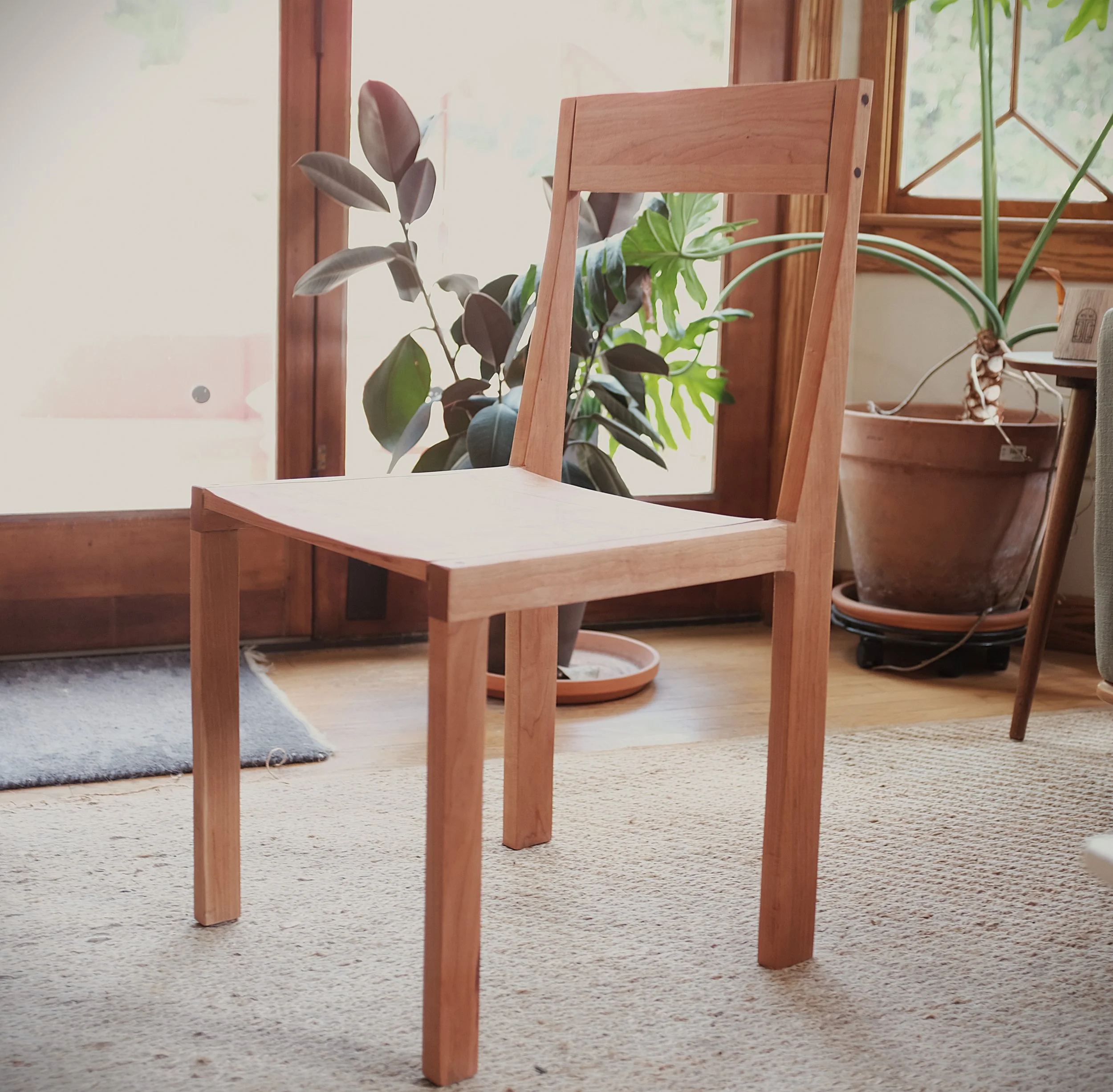
The Bare Chair (prototype 001)
I don’t mean to be irreverent, and I’m also not talking about butt joints (a real thing in woodworking). I do, in fact, mean the kind Sir Mix-A-Lot was talking about. The kind whose great variety was analyzed by Tim Wilson in a song that a younger and dumber version of me used to hijack those new digital jukeboxes in bars to play because it was funny to watch people react to it.
Butts are a serious issue, especially for woodworkers. You don’t need to read Freud to think it’s odd how they’re both fetishized and responsible for some of humankind’s greatest taboos. To the extent that we find them pleasing, my theory is that it’s maybe in part because they evolved to provide maximum comfort, a wearable marshmallow to make sitting more soothing. To the degree that we don’t love them, I don’t think it’s because of the taboo stuff, but because not even nature’s marshmallow can handle the amount of sitting we do in modern times. A good chair is supposed to help with that.
There are two ways of approaching this problem. One is to double down on the evolutionary marshmallow strategy by adding a cushion. The other is to create a scoop to gently cradle it. When done right, both work fairly well. As for which way to go, that’s a matter of taste.
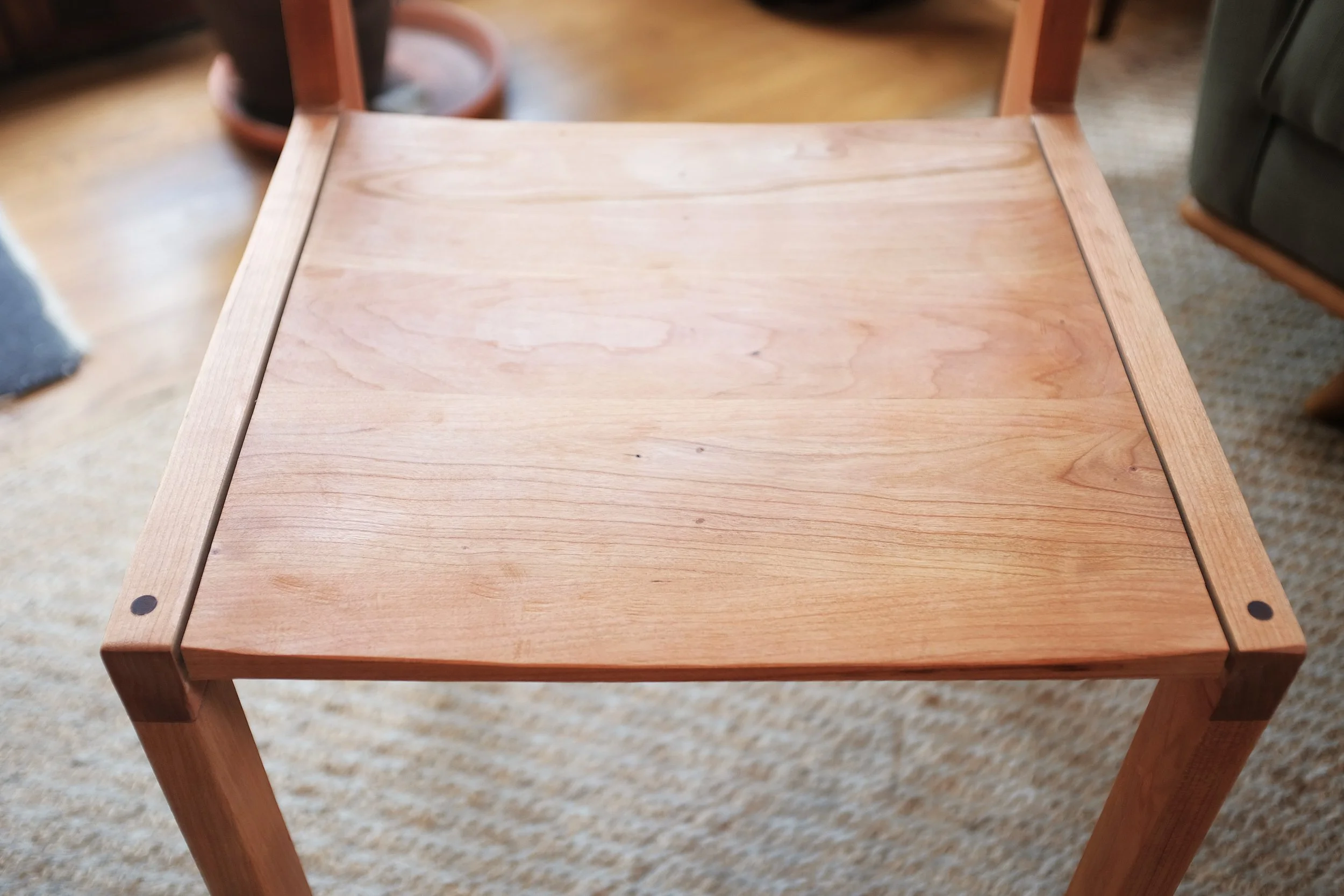
The aesthetic I was going for with this “Bare Chair” prototype is minimalist. Like I often do, I was browsing international furniture sites and came across a Finnish company called Vaarni. They specialize in just one type of wood, Finnish pine. That’s a bit unusual because pine, an inexpensive softwood full of knots, has long been out of favor in the fine furniture world (wood ethics-wise, however, pine is highly sustainable because they grow so dang fast). One of their chairs that stood out to me also stood out from the rest of their offerings. It incorporated plywood. The sides or frame of the chair are made of standard, construction-grade plywood, and the seat and backrest are made of pine. In an interview, the designer, who is French, talked about the process of convincing the people at Vaarni to let him veer from their all-pine devotion by incorporating a product commonly used for subflooring, siding, and roofing.
I’m not anti-plywood. It’s a staple of mid-century furniture, partly because it bends well and yet is really strong. I haven’t used it for furniture yet, but I will someday. Just the other day, our local lumberyard guy - Brett, with a hipster mustache - and I had a lengthy conversation about modern furniture-grade plywood technologies. It’s super interesting in ways I’ll probably write about in the future. However, I’m not on board with the low-brow-high-brow postmodern pine thing that Vaarni is going for. Still, this one particular chair appealed to me, and I wanted to try something similar.
What I liked about it:
Its overall austerity, or simplicity. It doesn’t read “contemporary” because there’s something almost traditional about it, but it does read minimalist.
The details, like how the seat sits flush with the sides of the chair, and how there’s a small 1/8th-inch gap or reveal between the seat and backrest and the chair sides.
The scooped seat (on top, not the bottom). On theirs, the backrest is also scooped on the front and flat on the back. I like the look, especially because so much of the rest of the chair is squarish. As for making the scoops, I stopped with the seat (foregoing the backrest) for reasons that will be revealed in a moment.
As with all prototypes, this one has issues that I’ll troubleshoot in the next iteration. A crucial test for a chair like this one is the lean-back test, and mine failed: when I sat in it and leaned back on the two rear legs, I heard a crack. There was a break, not from the mortise and tenon joinery, which held up fine, but where the back of the seat met the back of the chair. It’s hard to explain and doesn’t matter. I know how to correct that in the next one. Another issue is that the mortise-and-tenon joints holding the front legs to the chair rails aren’t solid. They have some wiggle in them. I’ll use different joinery on the next one. It’s tricky here because this chair’s visual simplicity calls for no bottom cross-bracing, which many chairs have for this very reason.
In short, I need to make some modifications to the chair to make it more stable.
The bigger, less easily solvable issue is the scoop in the seat that accommodates your butt.
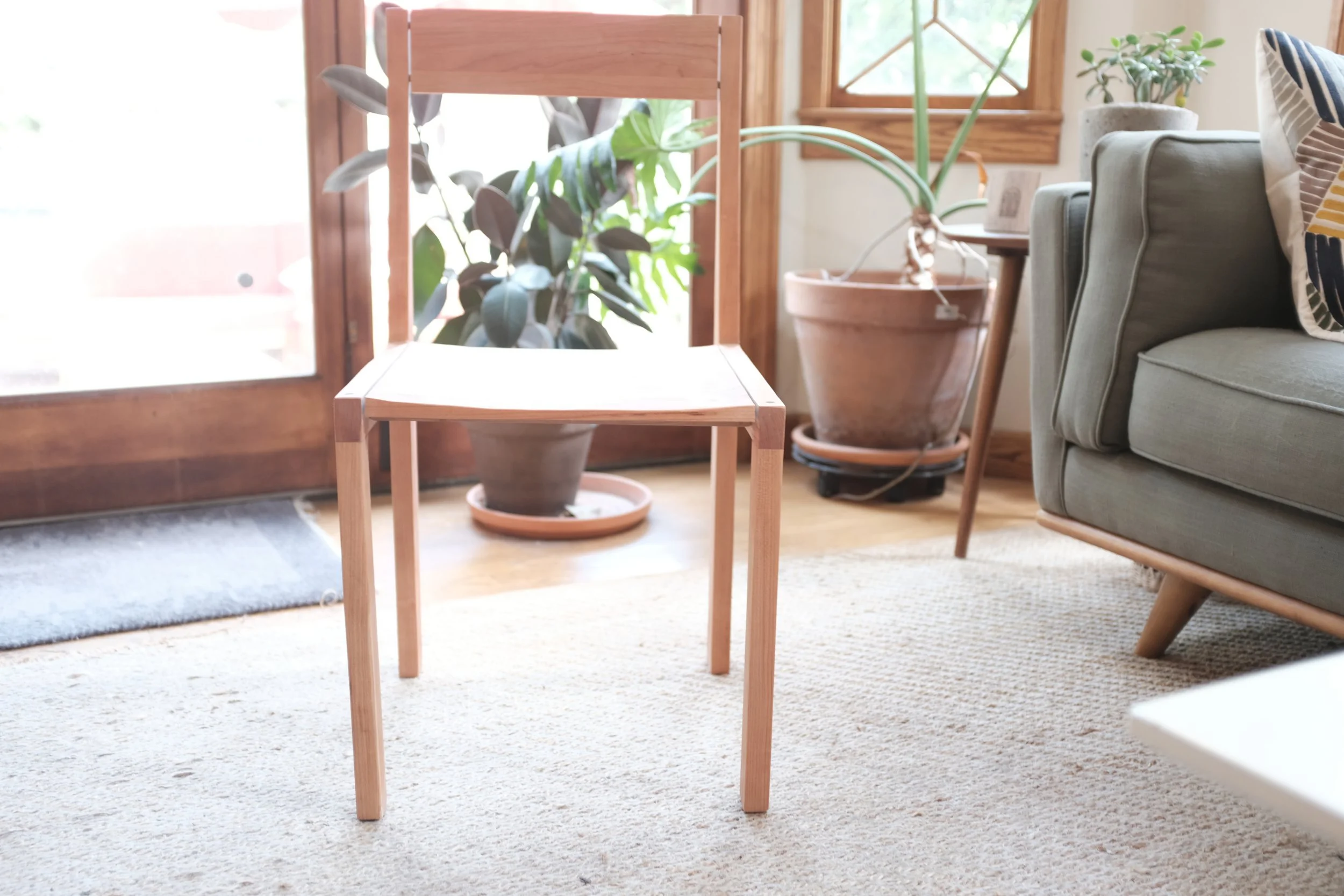
First of all, after carving the scoop, I realized the seat was too thin. It needs to be a thicker seat to account for the scoop. Otherwise, the proportions don’t look right. And second, I’ve learned that “carving” the scoop is not the best method. It was enthusiastically YouTube-recommended, but a closer look reveals it’s highly imprecise. The process is somewhat brutal, involving an angle grinder and a carving disc, often used to shave bark off trees and carve wooden bowls. The angle grinder's roughness and imprecision led to hours of subsequent sanding and subpar results. In the words of one of my favorite authors, that’s a supposedly fun thing I’ll never do again. I have thoughts about using the band saw instead.
I’m operating between two extremes. One is the traditional hand-tooler, who uses spoke shaves and whatnot to carve the scoop. The other extreme is the corporate manufacturer who programs a robot to carve the scoop.
Caring for the human butt is an age-old tradition with many technologies under its belt (I recognize the potential pun there, but it wasn’t intended). If you visit us, my dear friends, and sit in some future iteration of The Bare Chair, I just want your butt to feel cared for. Because that’s what we all want and need, a comfortable way to rest our legs, relax, and enjoy the company of others.
Tomorrow will be Day 1 of The Bare Chair prototype 002. Wish me luck. My butt is on the line.
