
Table Saw Reveal
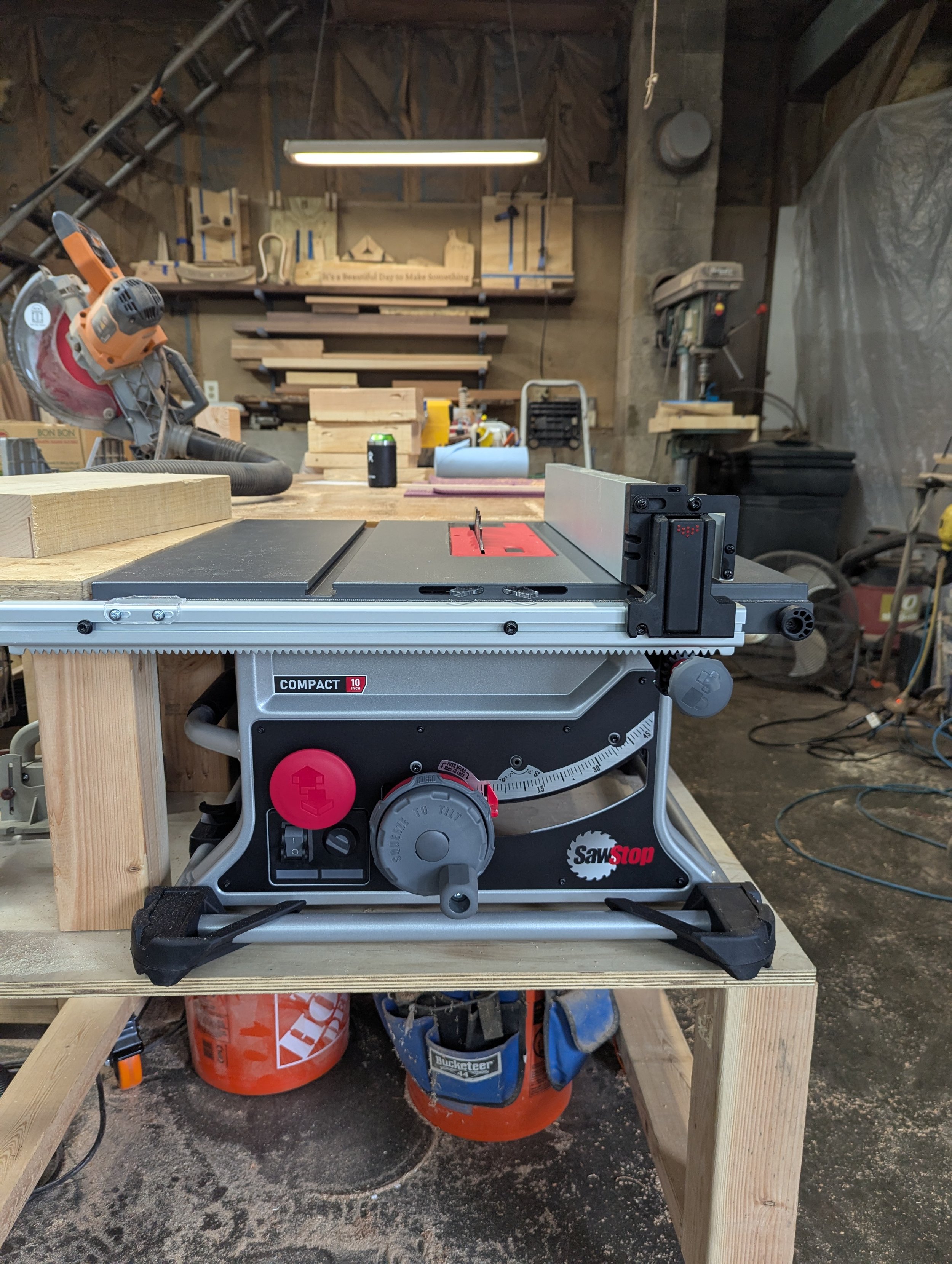
There it is, the new SawStop table saw. I’m currently putting it through its paces as I work on a dining chair design, and Faith is, too, working on a contemporary nightstand that will be donated to IRIS (Integrated Refugee and Immigrant Services) in New Haven, as they struggle to remain open. Fuck you, Trump. Fuck. You.
We’re still dialing it in, fine-tuning the blade and fence. We also had to deconstruct and reconstruct the shop table I made because its dimensions are slightly different from those of the DeWalt we had.
Here are the Good, Bad, and Whaaaaaats?
Good: It’s fine. It does what every table saw should do. Not better, but it gets the job done. One obvious Good compared to the others is that I feel so much less anxiety about accidents. Another is that it has a 10-inch blade, compared to the DeWalt’s 8 1/4-inch blade. That comes in handy. On a more wonky level, one feature stands out: a micro-adjuster that lets you change the blade angle to make beveled cuts. All table saws have a way to tilt the blade, but this one has a mechanism that makes micro-adjustments very easily and very carefully. I like that.
Bad: It’s weaker than the DeWalt. The SawStop has the same 15-amp motor, but the blade spins at 4,000 rpm, compared to the DeWalt’s 5,800 rpm. It might have to do with SawStop’s larger blade, I don’t know, but the difference is noticeable. Sometimes you have to struggle more to make cuts. But I get why. This is supposed to be a mobile saw that a construction worker can carry to the jobsite. The SawStop’s “Active Injury Mitigation” device weighs a lot, so they compromised by reducing rpm (and thus power). Even doing that, it’s still quite a bit heavier than the more powerful DeWalt. Jobsite saws are intended for framing construction, which involves softwoods like pine. This saw would have no trouble with that. But for making fine furniture with hardwood as we do, it struggles a bit. And that’s fine. You just go slow. And we’re not carrying it around, so weight isn’t an issue. We probably would have done better with their contractor or cabinet saw, but I couldn’t reconcile the cost difference.
Whaaaaaat?: There was a lot of emotional buildup to turning it on for the first time, but that moment was a WOMP Womp womp letdown. It has a deceptively complicated cockpit with lights and various switches, buttons, and whatnot, some of which you pull, others you push. When I turned it “on,” nothing happened except green and red lights flashed. You have to wait until the red light stops flashing and it’s only the green, and then pull, not push, the big red button. Before I figured that part out, I tried turning a small grey lever next to the on/off switch, which did nothing. It turns out that the lever is a bypass mechanism in case you’re cutting anything conductive and don’t want to trigger the Active Injury Mitigation mechanism (which is expensive to replace), such as wet wood or foamboard insulation with aluminum sheet surfaces. Doing so involves paying attention to intricate green-and-red light-flashing patterns. The flashing light chart on the side of the saw purports to explain everything in depth, but I lack the patience to study it.
Conclusions: It’s an insurance policy that works perfectly fine. And we’re up and running again. Stay tuned for my dining chair and Faith’s nightstand. Toodaloo!
Credits: “Good, Bad, Whaaaaaat?” is a regular segment on one of my favorite NBA podcasts, The New York Times Athletic NBA Daily Saturday Slam-N-Jam. Here is co-host Alex Speers delivering the opening line.
Copy-editing and sound clipping provided by Faith.
