
New Series Drop: Craft Value Part 1
I have no idea how many parts there will end up being to this probably intermittent series on craft value. It’s something I’ve become so absorbed in lately that I’m reading books about it and may well write one myself.
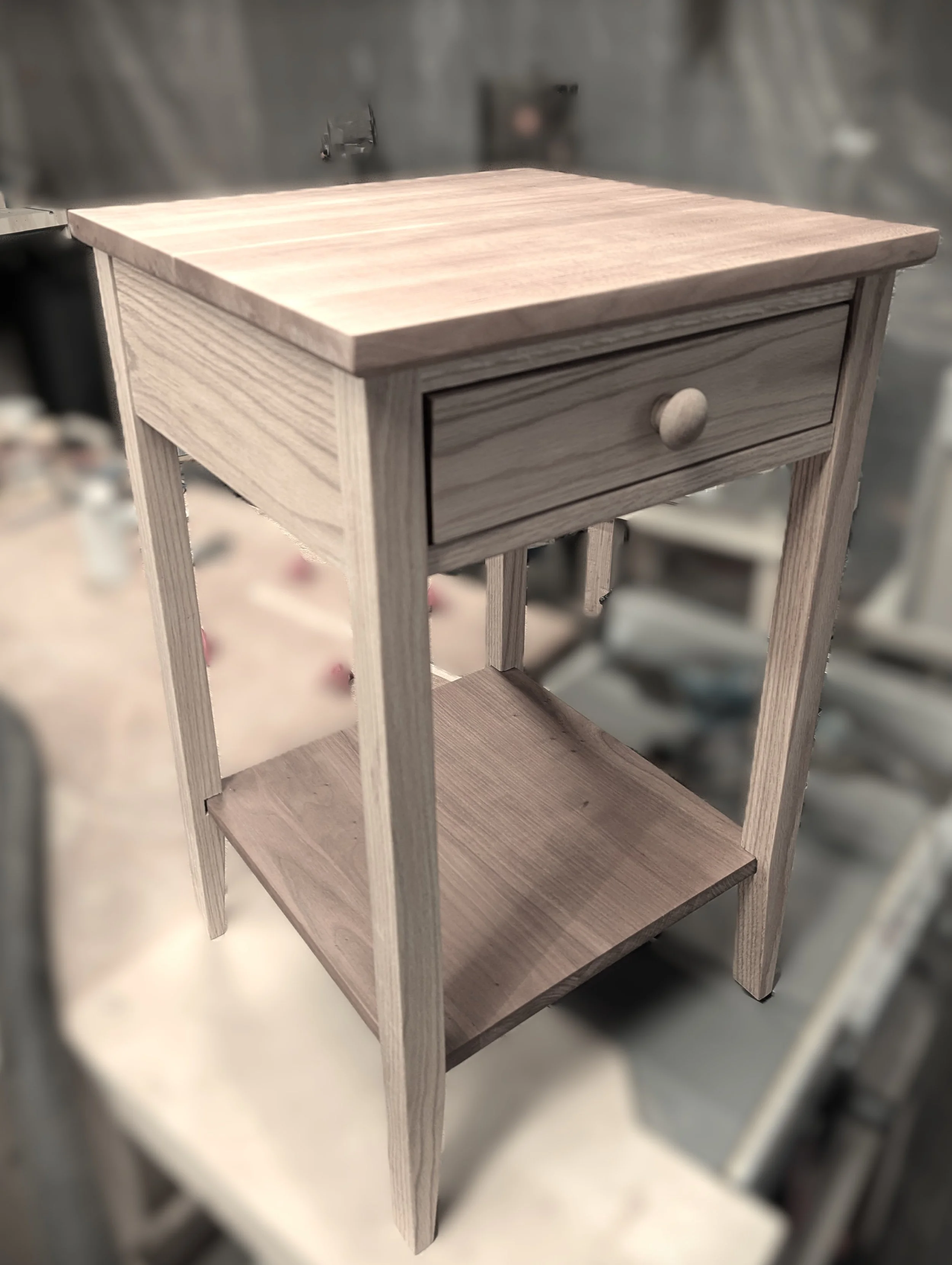
Consider the simple side table. It has a drawer and a bottom shelf. You could also call it a nightstand. I prototyped one because my friend Scott will be visiting in a few days and wants me to help him make one for one of his daughters. The one I made hasn’t been glued up yet; it’s a dry fit. I wanted us to be able to deconstruct it when he gets here, so he can see what the construction is like, all of its mortises, tenons, and dowels. Scott studies texts and analyzes their construction. I want him to see furniture that way.
I put a shit-ton of thought into it, not the materials (I didn’t care what they were), but more so the joinery and the quality-furniture-maker’s age-old concern about wood expansion and contraction, particularly with panel parts like the tabletop and bottom shelf. The solutions I came up with should make his daughter’s table an heirloom piece. I think it’ll last a hundred years, at least; that’s the benchmark I’m going for. I don’t know if that’s what will happen, but my own adult kids have furniture I made for them before they were born, and they’re in fine shape.
I recently made arrangements with a local non-profit to donate my prototypes, having exhausted the list of friends I could offload my experiments to. It’s an immigrant and refugee resettlement organization called IRIS (Immigrant and Refugee Integration Services) that’s facing hard times due to federal funding cuts. They’ll soon receive a side table, stool, and cutting board, with more in the pipeline. I won’t get anything for it, but that feels valuable to me.
So does helping Scott with the table he’s making for his kid. Part of what got me thinking about “value” is that I’m anxious about finishing it in the time he’s here. We have two full days and two half days, three in total. I never spent more than two hours at a time working on the prototype, and I didn’t work on it every day, so it took about two weeks to make. Granted, prototypes take longer because you’re working out the kinks and problem-solving. That’s why I prototyped it, so that it would go faster when he’s here. But I still wonder whether we can finish the thing in what amounts to a 24-hour time period spread across four days. I’ve already told him he’ll have to do most of the sanding and finishing when he gets home. Can we finish the construction in the short time he’s here? Hell if I know. Fingers crossed.
I think we can, and the table’s “value” will be immense. It’ll be time well spent tooling around in the barn with my best friend, resulting in a piece of furniture that, hopefully, his kid will have and cherish her whole life. There will also be some sentimental flourishes, like a hand-written message from Scott laser-etched into the drawer (courtesy of Faith and MakeHaven).
But aside from resettled refugees and Scott and his kid, how should I think about the value of this and any future side table I make, or anything else, for that matter?
Tuesday: 4 hours
Wednesday: 8 hours
Thursday: 8 hours
Friday: 4 hours
Total: 24 hours
Times 2 people: 48 hours
Plus material, equipment, and energy costs
Times what? I mean, what’s the value that I should assign to our labor in any other not-non-profit, non-sentimental setting? There are at least two ways of getting at this.
MIT publishes an online Living Wage Calculator for each US state. It breaks things down, firstly, into one adult working (with 0, 1, 2, or 3 children), two adults, with one working (and 0, 1, 2, or 3 children), and two adults, both working (0, 1, 2, or 3 children). It further breaks those categories and subcategories down into living wage, minimum wage, and poverty wage.
To be clear, Faith and I both teach at colleges; I teach full-time, and Faith teaches part-time. This is not an exercise in making woodworking a means of survival. If all we ever do is make things for friends and IRIS, but break even on materials and equipment, we’ll end up with a super fun and meaningful hobby. Still, I’m curious about how to assign economic value to our craft, which, to again be very clear, isn’t a cheap one.
According to the calculator and our respective life situations, the break-even cost for Scott and me to make a table for his kid, if we wanted to do it at a living-wage level rather than just for the fun of it, would be well north of $1,500. That’s what the side table would cost if we sold it to someone delirious enough to pay that much for it. One could say, and you might already be thinking, that if you apply living wage standards to all goods and services, they’d all cost a bunch more than what we’re used to. If Scott and I could even get a still-unrealistic $500 for a side table, we’d be working at a poverty-wage level, per the MIT calculator. But it’s more likely we’d get a third of that. Maybe $150. And the answers to the “Why?” questions are obvious: Amazon, cheap imports, cheap materials, automation, robots making side tables all by themselves, robots making side table-making robots, etc. It’s a story as old as the Industrial Revolution, updated with and exacerbated by newer supply chains and fancier computing and machinery.
The second way of approaching the craft-value question has been suggested by the authors of umpteen books on my shelf right now. Instead of an economic analysis, they offer psychoanalysis, or, rather, its distant and diminished cousin, self-help. Look no further than Shop Class as Soulcraft for craft’s version of Chicken Soup for the Soul. Craft invites patience and attention. It habituates a well-lived life. It’s an antidote to online, digital, AI enshittification. And so on. In my readings so far, I’m finding the sociologist Richard Sennett’s The Craftsman somewhat more thoughtful but still ill-attuned to the quagmire of craft value. More on that in a future post.
Like framing a house, or even constructing a side table, I want to frame the problem of craft value as sturdily as I can before embarking on this new series. There is a clear disconnect between what was once called “socially necessary labor time” (SNLT) and the highly wishful, nostalgically throwback, 21st-century craft movement. If you asked me to, I could make you a beautifully hand-stitched leather Field Notes journal cover, as I did for Faith and Scott, and the living-wage cost would be about $200. Or, you could buy the same thing on Amazon for $20. The process of making it would be valuable for me because I enjoy it, and maybe you would value it knowing I made it. But is that worth it? Would it be a “good value”? WTF is value? SNLT says it’s the average time to produce a thing under a set of given conditions. These days, the set of given conditions includes programming a computer to tell a robot to make it in five or so minutes, the time it would take me to select the leather. I’d still have to lay out the templates, mark the leather, make the cuts, do the hand-stitching, burnish the edges, and condition the leather. SNLT leaves me in the dust, so what’s the point? Where’s the value?
From what I can tell, there is no money in craft today unless you do what we were told by a small business advisor recently, which is to specialize in one product, one only. He suggested our stools. And to have them marketed and sold by a large distributor like West Elm or Wayfair. No more prototypes, no experimentation, no creativity. Batch out that one thing, make it efficient, do it quickly and consistently. I’ve written about this in a previous post, where I was mildly encouraged by it. I’m now questioning it.
I’m going to be exploring craft, value, and the value of craft in our contemporary day and age in future posts. The ordinary economics of it all feels like a veil over the existential meaning and contradictions of it all. If you knew me, you’d know that’s the kind of thing that gets me going.
I’ll end with a not-wholly-unrelated story of my friend Marquis, also my electrician, who came over to the house yesterday to hang new lights in the barn and then hung out for a burger and drinks. Marquis always likes to recount that I gave him his “first chance” as an electrician when he was a young buck in the trade, two years into apprenticeship, and I hired him to install a bunch of recessed lights, basement lighting, and a generator in my first house, before moving to this one. He had very little idea what he was doing. Every job took weeks to finish. He had to bring help to, in his words, make sure he didn’t “end up burning the house down.” He charged me a fraction of what he should have. He became a good friend. He’s now a journeyman electrician with his own apprentices. He charges me what his time and experience are worth, and I love it. At the moment, he’s doing a job for the NBA Hall of Famer Carmelo Anthony (I was a huge fan), whose massive house (Marquis showed us videos) is being refurbished after a flood. He’s getting paid what he’s worth. Marquis, the son of Jamaican immigrants, has gained value in his craft through a throwback, feudal-type system of apprenticeships and journeymen. If it’s worth $1,500, that’s what he gets. If it’s worth $15,000, he gets it. As it should be. To date, there are no robots that make robots that do electrical work in your home. It’s a valued craft. I’m proud as hell of Marquis. I mean, there’s an indirect line from me to Marquis to three-time Olympic gold medalist Carmelo Anthony. Just saying.
Professional basketball is a craft, and players are valued for it. A professional electrician masters a craft, and they’re valued for it. But robots and AI pose a threat to the value of other crafts. Going forward, I want to wade through this question of craft value as a set of concepts in its own right (What is craft? What is value?). Should be fun.
