
Wood Ethics Part 3: An Inconclusive Ending
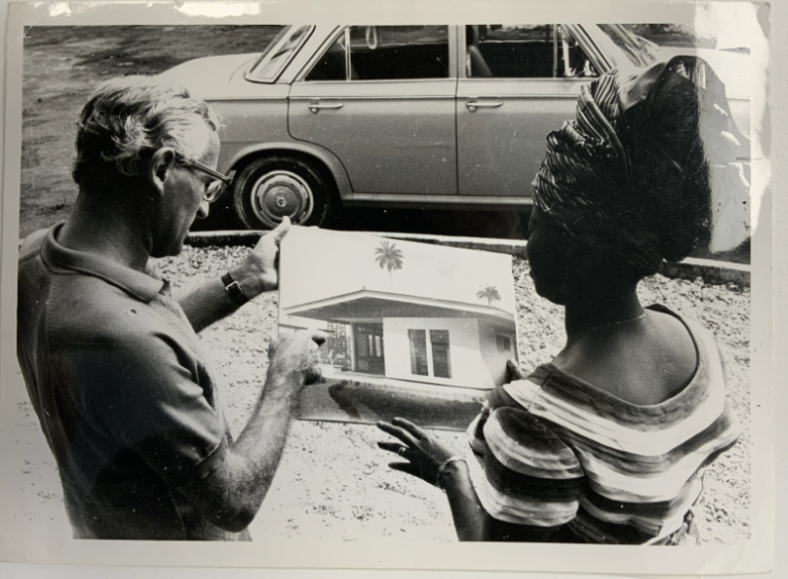
A British salesman for the United Africa Timber Company in Nigeria is pitching a prefab house made from Nigerian-sourced and produced plywood to a local woman.
In Wood Ethics Part 2, I said I would write about sapele, violins, colonialism, etc., and I will. Exploring the world of wood sourcing has been brain-tingling, but also unsettling, as you might have expected. That’s partly because it’s not just about wood, but also about the handmade craft movement in general, which is its own Pandora’s box of moral quicksand, and about aspects of how the world works that are depressing and impossible to individually escape. But, unlike in The Matrix, when Cypher (in the betrayer’s role of Judas Iscariot) preferred ignorant bliss to knowing his sumptuous bite of steak was fake, I’d rather know when and how my eco-social responsibility fantasies are delusional. Not fun, but better than living in denial.
I have just three reference points to draw your attention to in this (for now) concluding journey through Wood Ethics.
The first is a documentary film simply and efficiently called Wood. A group of DC-based investigative non-profit do-gooders went to risky lengths (using spy-cams and disguises) to pinpoint and expose illegalities in the global lumber supply chain that, in these cases, originated in the Amazon and Eastern Russia, was trucked into China or some other (heretofore) nearby trade-friendly place, and wound up in the hands of US suppliers like Lumber Liquidators, which subsequently went bankrupt and closed its stores in 2024. The film is overall a little boring but worth watching - boring because it’s mostly non-English without subtitles, and worth watching because of what you see. You see the conspicuous difference between the makeshift forest encampments of illegal loggers in remote, mud-ridden places worldwide, the cigarette-smoking middlemen in dingy mobile home-trailer offices somewhere saying, “Yeah-sure, we can get it for you, because even if we exhaust everything in this country, we can easily move across the border for more,” and American teenagers taking a break from playing video games to work part-time jobs in wood-flooring retail stores joking about how nobody actually knows what species are in the boxes they sell, how the flooring in boxes from different brands all look the same to them, and how they like customers who only want to know the square footage cost (it’s printed on the boxes).
The second reference point is a super-interesting blog called Transnational Architecture. It looks like something on the cusp of Wayback Machine status. One post, titled “The United Africa Company [UAC] archive: December Updates,” offers a trove of information about the United Africa Company and its spinoff, the United African Timber Company (UATC), later rebranded as the African Timber and Plywood Company, after foreign investment and industrial development took hold.
It’s not an African company; it’s British, and it’s located in Sapele, Nigeria. Like Lumber Liquidators, it folded in 2024. UK architecture school bloggers are taking advantage of the trove of company archives now available for public consumption to retrace the steps of how a British business negotiated with one of Britain’s former colonies, one that retained commonwealth status after “independence” in the 1960s, to continue harvesting its tropical wood for what the Brits referred to as, no kidding, “empire timber.” It’s right there in the archives.
Empire timber consists of rubber trees, for one thing. Rubber tree plantations are perhaps the most profitable of all because, for most of their life cycle, their sap is used to make tires for cars and trucks. After they become too geriatric to produce rubber sap, rubberwood can be used as a decent medium-density hardwood for furniture production instead of being burned or landfilled, as it used to be. A big percentage of what you find on Wayfair today is made from rubberwood, and they’re not sorry about it. It’s inexpensive because it was long considered waste, and they argue that using it for furniture is more eco-friendly than burning it or landfilling it. They might not be wrong, assuming you accept our rubber-consuming automobile fetish as a fait accompli that will go on forever. (Disclosure: We have a pair of rubberwood barstools from Wayfair in our workshop. They were demoted there from the house because I don’t like them. The wood lacks personality, and the construction is cheap.)
The city of Sapele was also a major producer of mahogany until it became certifiably endangered. Mahogany had long been a prized wood for British furniture and musical instruments, such as guitars and violins, so the market shifted toward the city’s namesake, sapele, with similar reddish-brown, tight-grained qualities. Sapele (the city) has been logging the heck out of sapele (the wood) ever since. It’s still the main source of sapele for the global market, which makes me feel some type of way because we (at ECW) buy, use, and love the sapele we get from our local, aspiringly responsible lumber provider. Sanded and finished well, it has a unique feature called chatoyance, an iridescent optical effect typically associated with gemstones.

Conrad Design Group
A related British company, Conrad Design Group, used UATC’s sapele and walnut to make some fairly cool modern office and home furniture. In the postwar era, African timber fed British modernism, and British modernism shaped African offices and homes.
Here’s the thing. By all accounts, sapele wood from Nigeria, Ghana, and other parts of tropical West Africa is as responsibly sourced today as any well-meaning part of the world can guarantee. The part of the story that lacks luster for me is that the lumber industry in Nigeria is a classic case study of how decolonization unfolded in much of Africa. For one thing, the continent was carved up into states by European colonial powers, with borders that variously bisected and merged tribal groups with long histories of strife among them, predating colonization. Nigeria was one of them, and its post-independence period, as happened elsewhere in Africa, was marked by decades of civil war from the 1960s to the 1990s. Civil wars in Africa are a direct result of European intervention and mapmaking. For our purposes, the more relevant aspect of this history is that decolonization took on different forms across Africa. Algeria fought a bloody revolution against France and wanted total independence after the war. But elsewhere, as in Nigeria, independence came in the form of “protectorate” status, which gave colonial powers like France and Britain (in Nigeria’s case) continued rights to invest and extract natural resources. Nigeria’s new post-independence currency featured the image of Queen Elizabeth, who would sometimes visit as the monarch and formal “protector.”
The United Africa Timber Company is a perfect example of this all-too-common transition away from colonialism toward a new kind of economic imperialism, a neo-imperialism with numerous spinoff consequences, such as the ravaging of Nigeria’s sapele forests, oil, and other natural resources. It’s a stable country today with a fast-growing economy. The population of Lagos (in Nigeria) isn’t quite like Jakarta or Tokyo, but it’s way more than that of New York City or Los Angeles, and it's rapidly modernizing. Post-1990s stability has enabled it to protect forests and regulate the timber industry to ensure sustainability. Now that I’ve studied it, I don’t feel worried that the sapele we buy might be illegally or irresponsibly harvested, but, wood-ethics-wise, that doesn’t mean there isn't a slight ick factor when I think more broadly about sapele’s role as a colonial and postcolonial commodity to source violins for Beethoven concertos in London and armchairs for the royal family. The same goes for rubberwood. The difference, though, is that I’m indifferent to rubberwood, but I love the iridescence of sapele, that gorgeous luster, and it’s that lure and attraction that made sapele so sought-after in the West in the first place.
The third and final reference point traffics in similar ambiguities and ick factors.
I’m reading a book called The New Politics of the Handmade: Craft, Art, and Design, circa 2020. For pace-of-traditional-publishing reasons, it sometimes takes about 10 years for bodies of literature and critical-theory responses to recent events to emerge in print, and this one is no exception. A cursory Amazon or humanities internet database search will confirm that a shit-ton of books and articles about craft and the handmade movement started in earnest in 2008, for one obvious reason (the Great Recession), and is still proliferating to this day. A more expansive view might suggest that 2008 was already belated. After all, the maker movement began in earnest in the 1990s as a tech/DIY phenomenon, with maker fairs that led to the invention of touchscreens and smartphones. Apple’s early role in the construction of the maker fad is a tell-all story about what the editors and authors of The New Politics of the Handmade, years later, framed as the tension between ‘craftivism’ and ‘craftwashing.’
Actually, they describe craftivism and craftwashing as follow-up trends that came on the heels of an explosion of literature idealizing craft, making, etc., i.e., as an existentially uplifting thing to do and discover, a way of reclaiming human authenticity, especially in an age of mass consumption and production and hard economic times (these days, “hard economic times” feels like a quaint exception to a norm that no longer exists for most people). All told, then, they offer not two, but three criticisms. The first is a criticism of upbeat/heartfelt craft positivity that, they say (in academic jargon I know all too well), is both an expression and manifestation of contemporary neoliberalism. Translation: Books with titles like Shop Class as Soulcraft and Why We Make Things and Why it Matters (among dozens of others) peddle a pernicious ideology of entrepreneurial individualism in an age when (because of neoliberalism) social support systems are shrinking, wages aren’t keeping up with inflation, and everyone’s looking for a second or third side-gig to keep themselves afloat. Calling it soulcraft, they suggest, is just another form of the “opiate of the masses.”
Their second critical target, craftivism, is the rebranding of craft and the handmade as an imagined middle finger to Amazon and other corporations. It’s not just that we do it for fun; this is the revolution. I’ve seen this in the knitting community. A local coffee shop where I used to write held weekly Stitch-n-Bitch events with robustly tattooed women and queer folk knitting raised-fist imagery into shawls, sweaters, and whatnot. The authors of The New Politics of the Handmade have issues with this, too. Using well-crafted academic jargon, they said it was the appropriation of revolutionary rhetoric and, at times, the cultural appropriation of domestic women’s fabric and textile practices in the Global South. It gets worse, as usual, when fast fashion, designer brands, and platforms like Etsy (after they go public) craftwash the living shit out of everything, whether it’s craft idealism or craft activism (oops, “craftivism”). Craftwashing: that’s their third critical target. I don’t disagree.
Wood Ethics Part 3’s major throughline is unsurprisingly low-key depressing, and it’s this. I somehow can’t responsibly (with certainty and in light of historical context) buy wood and feel completely great about it. Can’t I add a little meaning, challenge, and enjoyment to my life by making things and feel okay about it? Apparently, I’m coopted, coopting, or some cog in the wheel of a grander scheme of neoliberal cooptation. I don’t know which, but The New Politics of the Handmade tells me it’s at least one of them.
I’m unsatisfied with these narratives, and I’m searching for others. I don’t mean for that to sound like a TV-plot, series-ending cliffhanger, a ploy to keep you reading future posts. I’m just saying, I know this syllogism like the back of my hand.
Proposition 1: The world sucks.
Proposition 2: Everything people try to do to get around it is either facile and individualistic or swiftly coopted.
Conclusion: All that’s left to do is to be sufficiently critical about how impossible it all is.
It’s a syllogism that has worked for me in my professional life as an academic philosopher. The title of an essay by a philosopher I like is “The Ruthless Criticism of Everything Existing.” But as a woodworker, I want my criticism to lead somewhere, to result in something. For me, the search for that “something” is part of how I’m trying to build a content, balanced, meaningful life.
It shouldn’t be this hard, but here we are. See you in the next one.
