
Wood Ethics: Part 2 (of 3!)
If my obsession with this issue wasn’t obvious enough in the previous post, adding a Part 2 should make two things crystal clear: the obsession is real, and nothing is all that clear to me, still.
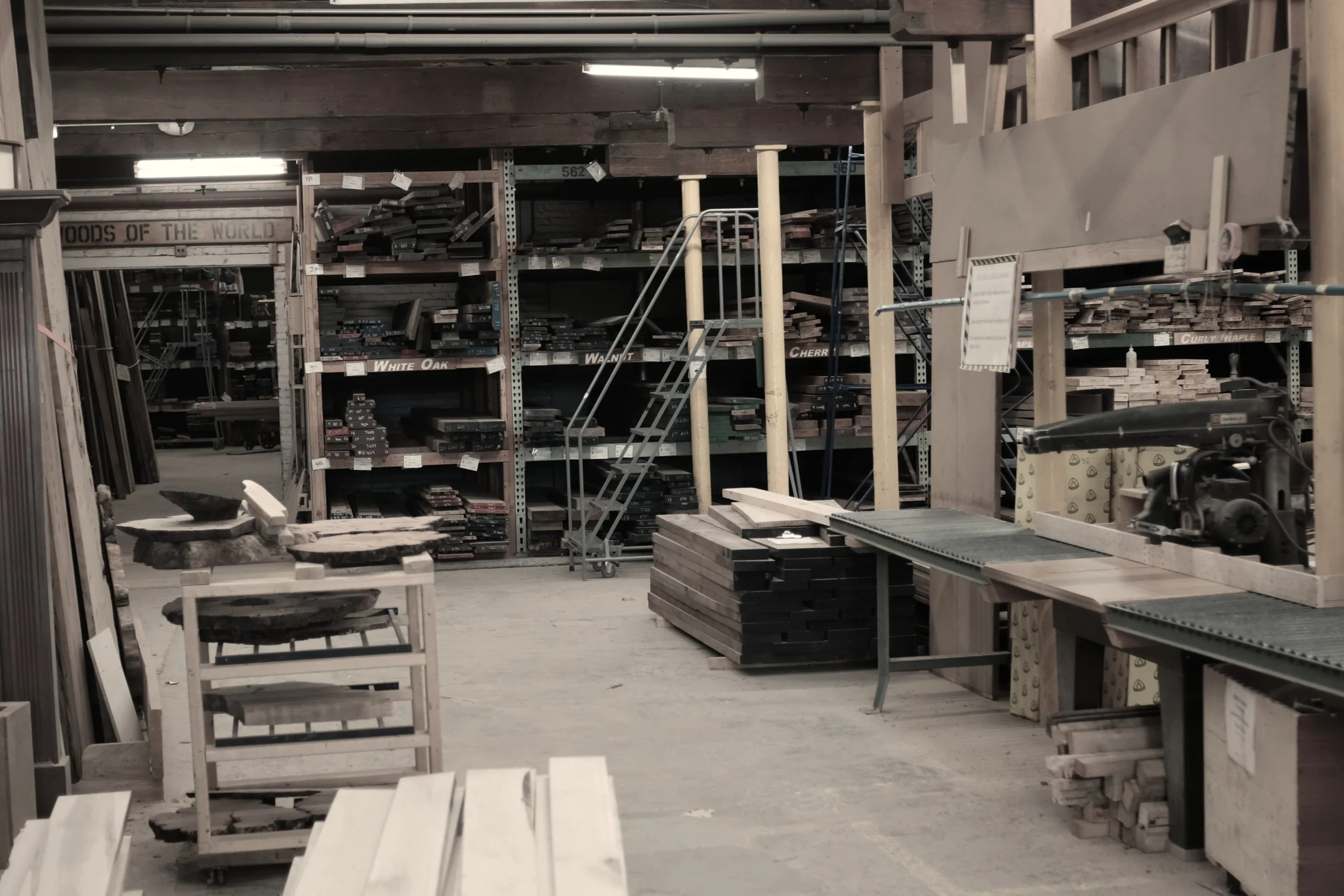
After writing “Wood Ethics,” I spent more time on the Parkerville Wood Products website, looking into how they source wood and the certification programs they work with (here’s a previous post about our trips to Parkerville). There wasn’t much on the site about that, but the last sentence of their “Our History” page said they were in the process of becoming designated a “green aware” company. Everything else on this page of their site was about David, who served in the Peace Corps and then returned from wherever to become a cabinetmaker. The business morphed into something apparently huge, doing projects for Yale University and Mohegan Sun (a casino/resort here in CT), both of which, if you’ve ever been, you’ll know, have extravagant woodworking all over the place. David sold the business after receiving an offer he couldn’t refuse, but the offer came with a caveat. The buyers had no interest in maintaining the wood-sourcing sector of his little woodworking empire, so David kept that and ran it with his son, Brendan, who is in charge of operations to this day. They became Parkerville Wood Products. But the nagging question for me was, what does “green aware” mean? Is it like, “green curious”? Are there certifications for simply knowing that bad shit happens in the lumber industry? I had to know, so I called.
“Hi, my name is Matt. My partner and I have an account with you, Elm City Wares. I have a couple of questions that are probably not what you’re used to being asked.” I said I was curious about the “green aware” thing and would like to learn about their certifications, how they source wood, their vendors, etc. “Right. Let me see if I can get someone who can help you.” I dropped the “have an account with you” line because it occurred to me, as I started talking, that I might come across like some prying investigative journalist. I suppose those things are true. I was prying, I was investigating, and here I am reporting it to you. But not maliciously. I was able to explain myself better when the “someone who could help me” got on the line. It was Brendan.
I repeated my questions to Brendan and told him something genuinely true: we are working with two small business incubators, one at the University of Connecticut and one called Nest, which provides consulting and matches makers worldwide with retailers like West Elm. Both emphasize that customers value genuine, evidence-backed, environmentally friendly practices in the small businesses they support. Brendan immediately got it because they supply lumber for small businesses, and because they, too, are making an effort to meet that expectation. So here’s what I learned.
“Green Aware” is not an official certification from a single body or organization, but it is a recognized business-world label for companies doing their damnedest to be ethical and eco-friendly. Different industries have specialized organizations that provide specific certifications, such as LEED (Leadership in Energy and Environmental Design) for architecture and building construction, and FSC (Forest Stewardship Council) for lumber sourcing, and for any kind of woodworking business, from plywood to cabinetry, paper, and furniture. In most sectors, you can break it down to questions of material sourcing and waste. Parkerville’s “green aware” commitments address both, but their biggest accomplishment so far is on the waste side. Because they still have manufacturing operations (I was able to take a tour and see them building commercial cabinets with a super-sized CNC machine and a bespoke bar for a local restaurant), they run industrial-grade machines with a massive, tentacular dust-collection system whose numerous spurs connect to a central duct that exits the building and fills a cargo container (see the thumbnail image for this post on the Blog page). Brendan told me they rent the cargo container from a local company in Berlin, CT, called BioPellet, which turns sawdust into biomass fuel for pellet stoves and BioBricks for fireplaces and firepits. The amount of money that BioPellet pays them for the sawdust equals the cost of renting the cargo container, so it’s a wash for them financially, but they can assure customers that they’re doing something good because they’re “green aware.” So it goes.
I later called BioPellet and talked to Steven. “I’m a Parkerville customer, and they told me you turn their sawdust into wood pellets and bricks.” I asked if we could drop off bags of our own sawdust for pellet and brick production, and told him about our environmentally friendly small-business quest. We didn’t want money for the sawdust; we just wanted a way to keep a few bags of sawdust from going to the landfill each month. Steven was curiously enthusiastic and couldn’t wait to meet us. By some stroke of good fortune or destiny, BioPellet is a mile away from Tandy Leather, which, for local geography reasons, we have begun to frequent when we visit Parkerville.
My conversation with Brendan then turned toward sourcing and certification of their lumber. Parkerville, he was disappointed to say, is not FSC certified, and the reason is weird. They want to be, and they do everything they possibly can to ensure their lumber is ethically sourced. He sent me links to FSC and a recent industry webinar he attended. The problem is that FSC certification has one oddball requirement that resembles the restaurant industry requirement about any and all kinds of nuts. Everything has to be majorly separated. The majority of Parkerville’s lumber is FSC-certified, but as a business, it isn’t eligible for FSC certification because its facilities aren’t large enough to store its FSC lumber in a separate room from its other lumber, regardless of how much effort they put into ensuring that the other lumber is also ethically sourced. I guess I’m not green-aware enough to understand how lumber has the same kind of contamination risk as nuts, but so it goes.
I hesitated to ask, but really wanted to know. “What about the other non-FSC-certified stuff, the tropical wood from Africa and Central and South America?” Brendan was admirably honest and straightforward. They do their best because demand for these illustrious, exotic woods is huge. The problem isn’t so much their vendors as it is the sourcing suppliers and supply chains. Brazil, for example, has rules, policies, and laws on the books about deforestation and indigenous displacement, but under Bolsonaro, they were aggressively ignored, to the point that even under Lulu’s new administration, forestry practices are so deeply instilled that it’s tough to regulate and certify what’s actually happening. Brendan, I believe, is a good man trying to run a transparent business in a space where transparency is really hard to come by.
I asked about sapele, an African wood species that has largely replaced the now-highly restricted mahoganies of the world because of its red-toned luster, and the endangered teaks of the world because of its natural resistance to rot and pests even under the wettest conditions. Even less clarity. We agreed that it’s the Wild West out there. Woodworkers love sapele. I use it and love it. My next post will be about sapele, high-end violins, philosophers, imperialism, post-colonial-independence African modernism, and more. Stay tuned, my friends. Wood Ethics Part 3 looks to be a doozy.
